Your Facebook comment section is public-facing real estate. Every comment is visible to potential customers deciding whether to trust your brand. A section full of spam, unanswered questions, and toxic replies tells visitors one thing: nobody is home.
Good moderation is not about censorship — it is about creating a space where real conversations happen and bad actors do not dominate. In 2026, with ad costs climbing and organic reach shrinking, the quality of your comment section directly impacts whether people buy from you or scroll past. According to Meta's own data, posts with active, well-moderated discussions see up to 50% more organic reach than those with unmanaged comments.
This guide covers every moderation approach available today — from Facebook's own free tools to AI-powered systems that understand context. Whether you run a small page or manage dozens of ad campaigns, you will walk away knowing exactly which approach fits your situation and budget.
Facebook's Built-In Moderation Tools
Facebook gives every page a basic toolkit for free. Here is what you get and where each tool hits its limit:
-
Keyword filter —Block or hide comments containing specific words. Set it up in Page Settings > Moderation. Useful for catching obvious slurs, competitor brand names, and known spam phrases. The limitation is brutal: no context understanding whatsoever. A filter set to catch "kill" will hide "This product is a killer deal" alongside actual threats. You end up hiding your best compliments.
-
Profanity filter —Facebook's own ML-based filter that scans for profanity across multiple languages. It works, but it is aggressive. Borderline comments that might be perfectly legitimate —a frustrated customer venting, a casual comment with mild language —get swept up alongside genuine abuse. You lose nuance.
-
Manual comment hiding —Click the three dots on any comment and hide it. The commenter does not know their comment was hidden, which avoids confrontation. The problem is scale. If you receive 200+ comments per day across ads and posts, manual hiding becomes a full-time job that nobody wants.
-
User blocking —Block repeat offenders from your page entirely. This is the nuclear option. It stops that specific person from commenting, but it does nothing about the next troll, the next spam bot, or the next wave of junk comments on your next ad.
-
Comment ranking — Facebook can display "most relevant" comments first, pushing spam and low-quality replies further down the thread. This is not moderation — it is reordering. The spam still exists. Anyone who clicks "All comments" sees everything. Your comment section is not actually cleaner; it just looks that way on the surface.
For a small page receiving fewer than 50 comments per week, these tools might be enough. You can manually review everything, hide the obvious junk, and reply to the rest. But the moment you start running ads — especially to cold audiences — the volume and variety of comments will overwhelm this approach within days.
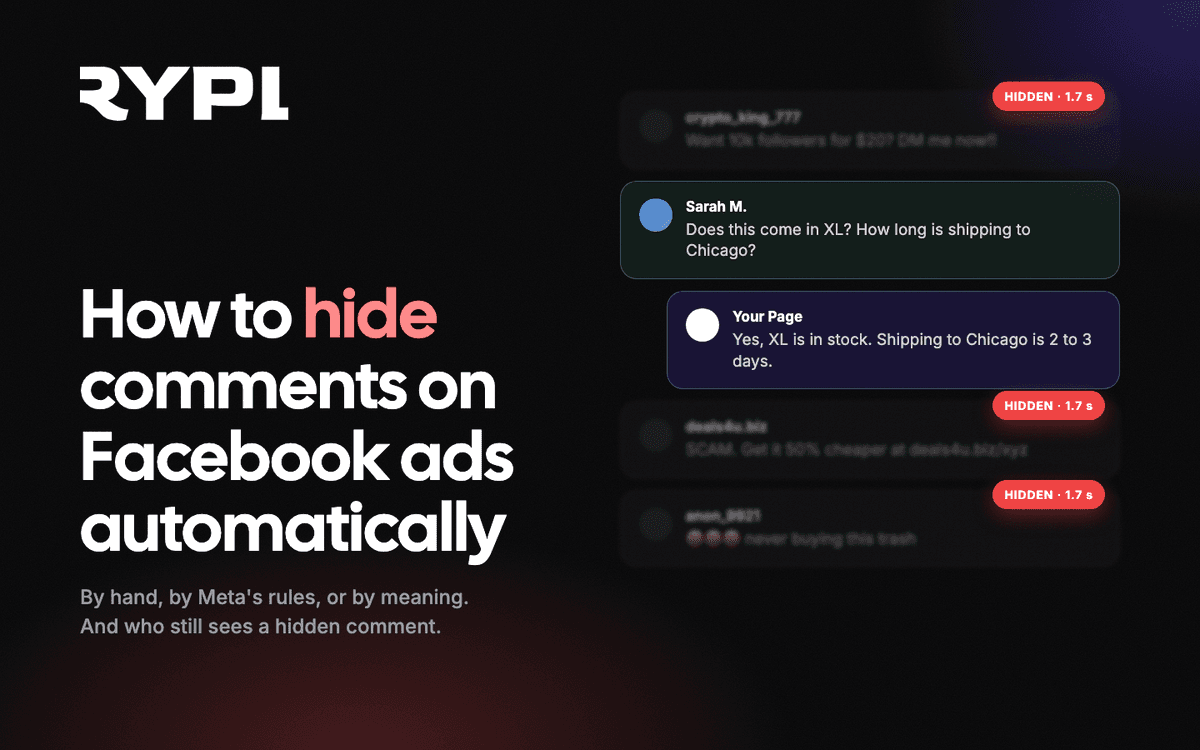
Step-by-step version of the native workflow, including Moderation Assist's full criteria list: how to hide comments on Facebook ads automatically.
Where Native Tools Fall Short
Three fundamental problems make Facebook's built-in tools insufficient for any serious page:
No Context Understanding
The keyword filter cannot distinguish between "This price is a steal" and "Someone stole my package." Same trigger word, completely different intent. One is a compliment. The other is a complaint that needs immediate attention. Native tools treat them identically because they operate on pattern matching, not comprehension.
This creates a lose-lose situation. Set your filters too tight and you hide legitimate comments from real customers. Set them too loose and spam pours through. There is no setting that solves both problems because the tool fundamentally does not understand what people are saying.
No Automation of Replies
Native tools can hide comments and block users, but they cannot respond. A hidden spam comment is fine —nobody misses it. But an unanswered pricing question is a lost sale that you paid to generate. Moderation without response is only half the job.
Consider the math: if your Facebook ad generates 100 comments and 30 contain genuine purchase intent, hiding the 15 spam comments is useful. But if you do not reply to those 30 buying signals, you have spent your entire moderation effort on the wrong problem. You cleaned the room but left the money on the table.
No Analytics
Facebook tells you how many comments you received. It does not tell you what percentage were spam, how many contained purchase intent, what your average response time was, or which ad creative attracts the most junk. You cannot improve what you cannot measure.
Without data, moderation becomes reactive guesswork. You hide what looks bad, ignore what looks neutral, and hope for the best. That is not a strategy — it is a prayer.
Here is a real-world example that ties all three problems together: someone comments "This looks too good to be true" on your ad. A keyword filter might ignore it entirely — no flagged words. A human moderator might hide it defensively, worried it makes the brand look bad. But the correct response is to address it publicly: "We hear that a lot — here is how it works..." That reply does not just satisfy one skeptic. It builds trust for every potential customer reading the thread. Native tools cannot make that judgment call.
Third-Party Rule-Based Moderation
Tools like NapoleonCat, Agorapulse, and Statusbrew add capabilities that Facebook's native tools lack:
-
Advanced keyword rules —Multi-word triggers, regex patterns, negative keywords, and conditional logic. Instead of just blocking "spam," you can create rules like "hide comments containing a URL from accounts less than 30 days old." More precision, fewer false positives.
-
Scheduled moderation —Auto-hide comments matching your rules even when your team is offline. Comments that arrive at 2 a.m. do not sit visible until someone checks in the morning. For brands running international campaigns across time zones, this is essential.
-
Team workflows —Assign comments to specific team members, track response status, and set internal SLAs. No more "I thought you replied to that one" conversations. Every comment has an owner and a status.
-
Multi-page management —Moderate across multiple Facebook pages, Instagram accounts, and ad campaigns from one dashboard. If you manage more than two pages, this alone justifies the cost.
-
Basic auto-replies —Respond with pre-written templates triggered by keywords. Someone asks "price" and they get a pre-built response with your pricing link. It is faster than manual replies and better than silence.
These tools represent a significant step up. They solve the scale problem for moderation and bring structure to what is otherwise chaos. Pricing typically runs $20-100 per month depending on the number of pages and team seats.
But they still operate on if/then logic —and real human comments do not follow predictable patterns. A rule that catches "spam" comments also catches "is this spam or legit?" from a genuine customer who is trying to verify your offer. A template reply to "price?" sends the same generic message whether someone is asking about a $10 product or a $500 service bundle. The rigidity that makes rule-based tools predictable is also what makes them robotic.
AI-Powered Moderation
This is where the approach fundamentally changes. Instead of matching keywords against a list, AI-powered tools like Rypl read and understand what is being said. They analyze three layers before taking action:
-
Sentiment —Is this comment positive, negative, or neutral? Is the negativity justified criticism from a real customer, or is it trolling from someone who has never bought anything? A one-star rant and a thoughtful complaint both contain negative language, but they require completely different responses.
-
Intent —Is the person asking a question, expressing purchase interest, filing a complaint, or just passing through? Intent detection is what separates "How much?" (a buying signal worth $50-500 in potential revenue) from "lol" (worth nothing). Rule-based systems treat both as comments. AI treats them as fundamentally different events.
-
Context —What is the post about? What has already been said in the thread? Is this the third time the same person has asked the same question? Context turns isolated comments into conversations, and conversations are where sales happen.
With these three layers working together, AI can do things that rule-based systems simply cannot:
-
Hide spam without collateral damage —AI distinguishes between a bot dropping links and a customer sharing a relevant URL. The keyword "free" in "Is there a free trial?" is a buying question. The keyword "free" in "FREE IPHONES CLICK HERE" is spam. AI knows the difference.
-
Separate frustrated customers from trolls —A customer saying "This took way too long to arrive" needs empathy and a solution. A random account posting "WORST COMPANY EVER" with no purchase history needs to be hidden. Both are negative. Only one deserves a response.
-
Handle sarcasm and nuance —"Oh great, another subscription service" could be genuine excitement or biting sarcasm. AI reads the surrounding context and responds appropriately rather than taking every comment at face value.
-
Work across languages automatically — No separate rule sets for English, Spanish, Portuguese, or French. AI processes intent regardless of language and responds in kind. For brands selling internationally, this eliminates an entire category of operational complexity.
-
Reply with context, not templates — When someone asks "Does this come in blue?", AI does not send a generic FAQ link. It checks your product catalog and replies with the actual answer. That specificity converts browsers into buyers. Rypl takes this further by connecting to your knowledge base, so every reply reflects real product data — not pre-written templates that go stale.
For a deeper dive on how AI compares to rule-based systems with real comment examples, see our breakdown on AI vs rule-based comment automation.
Building a Moderation Strategy That Scales
Regardless of which tools you use, you need a decision framework. Not every comment deserves the same treatment. Here is a four-tier system that works at any volume:
-
Always hide —Obvious spam (link drops, bot-generated text), profanity and hate speech, competitor advertising on your posts, and scam comments targeting your audience. No response needed. Just remove them.
-
Respond publicly, then hide if needed —Complaints with valid concerns deserve a visible reply before cleanup. Misinformation about your product should be corrected where everyone can see the correction. The goal is to demonstrate responsiveness, then tidy up.
-
Respond publicly, keep visible —Product questions, pricing inquiries, genuine feedback (even if negative), and customer stories. These comments add social proof and show that your brand engages with its community. A visible question with a helpful answer sells more than any ad copy.
-
Escalate to a human —Legal threats, PR-sensitive situations, deeply emotional complaints, and complex product issues that require specialized knowledge. No automation —whether rule-based or AI —should handle these. The risk is too high and the nuance required is too specific.
The most common mistake brands make is treating all negative comments the same way. A customer saying "Shipping took too long" is feedback you want to address publicly —it shows accountability. A random account posting "SCAM" with no context is noise you want to remove. The distinction matters, and it is exactly where simple moderation tools fail. For more on how unanswered comments specifically impact your ad ROI, see our piece on lead leakage.
Choosing the Right Approach
Here is how the three approaches compare across every capability that matters:
| Capability | Native Facebook | Rule-Based Tools | AI-Powered |
|---|---|---|---|
| Cost | Free | $20-100/mo | $19-89/mo |
| Setup time | Minutes | Hours | Minutes |
| Spam detection accuracy | Low-Medium | Medium | High |
| Context understanding | None | None | Full |
| Auto-replies | No | Template-based | Context-aware |
| Multi-language | Limited | Per-language rules | Automatic |
| Analytics | Basic | Moderate | Advanced |
| Scales with volume | No | Partially | Yes |
The right choice depends on where you are today:
-
Under 50 comments per week, no ads —Native Facebook tools are fine. You can manually handle this volume without burning out. Save your budget for other things.
-
50-200 comments per week, occasional ads —Rule-based tools start making sense. The structure, scheduling, and team workflows will save you time and prevent comments from falling through the cracks.
-
200+ comments per week, active ad campaigns —AI-powered moderation pays for itself. At this volume, the number of missed leads and poorly handled comments from rule-based systems costs more than the AI subscription. Every unanswered buying question is revenue you already paid to generate.
-
Multiple pages, international audiences, 24/7 campaigns —AI is not optional. The combination of volume, language variety, and around-the-clock activity makes any manual or rule-based approach unsustainable. Your competitors who automate with AI will reply in seconds. Your unmoderated comments will sit for hours.
There is one more factor worth considering: the cost of getting it wrong. A rule-based system that sends a cheerful pricing template to an angry customer makes your brand look tone-deaf. An AI system that reads sentiment before responding avoids that mistake entirely. At scale, the cumulative damage from robotic, context-blind replies is real — and it compounds with every misfire.
Start With the Right Foundation
Before you pick software, define your policy. Decide what gets hidden, what gets a public response, and what gets escalated to a human. Document your brand voice — the tone should stay consistent whether a person or AI is replying.
Looking for the software rather than the strategy? The Facebook comment moderation tool page covers what gets hidden, what gets answered, and how the Page connects.
Then match the tool to your actual volume. For most businesses running active ad campaigns in 2026, the crossover point where AI pays for itself is lower than it looks — often as few as 3-5 campaigns running simultaneously. At that point, the number of missed buying-intent comments from rule-based systems or manual workflows costs more per month than an AI subscription.
The cleaner your comment section, the more your ads work. Every visible unanswered question is a reason for the next viewer to hesitate. Every toxic thread that goes unmoderated erodes the social proof you paid to build.
Start your free 7-day trial and see what context-aware moderation looks like on your own page in the first week.