You spent hours building the creative. You tested five audiences. You watched the CPM settle into a comfortable range. The campaign goes live, impressions climb, and then something happens that most media buyers treat as background noise: people start commenting on your ads.
Some ask about pricing. Some want to know about shipping. Some tag a friend. Some leave complaints. And most of the time, nobody on your team replies. The ad keeps running, the budget keeps burning, and those conversations — the ones you paid to generate — just sit there unanswered.
This is the gap that kills ROAS quietly. Not bad creatives, not wrong audiences, not even rising CPMs. It is the total absence of a system for managing the engagement your ads create.
Why Facebook Ad Comments Matter More Than You Think
Facebook does not just serve your ad and forget about it. The algorithm tracks what happens after the impression. Reply rates, engagement velocity, comment sentiment — all of it feeds back into how aggressively Facebook distributes your ad to the next batch of users.
When someone comments on your ad and gets no reply, the algorithm registers that as a dead-end interaction. Stack up enough of those and your reach shrinks, your CPM rises, and your cost per acquisition creeps upward — all because of conversations you never had.
Then there is the social proof problem. Every ad comment section is a public storefront. When a potential buyer scrolls past your ad and sees three unanswered questions about sizing, pricing, or availability, they draw an instant conclusion: this brand either does not care or is not real.
The data backs this up. According to Locowise research, 8 out of 10 messages sent to brand pages go unanswered. Less than 20% of comments under business posts ever receive a reply. That means your ad comment section is almost certainly working against you right now, showing future customers a wall of ignored questions instead of confident, helpful responses.
Every unanswered question is a lost sale. At scale, this problem compounds fast.
The Real Cost of Unmanaged Ad Comments
Think about the economics of a single unanswered comment.
You already paid for the impression that brought that person to your ad. You paid for the creative that captured their attention. You paid for the targeting that put your product in front of someone who actually cares. Then they ask a question — and nobody answers.
That is not a customer service failure. That is wasted ad spend with a receipt.
Here is what the leakage looks like when you put numbers to it:
| Scenario | Impact |
|---|---|
| 100 ad comments per week | ~30 contain purchase intent |
| 80% go unanswered | 24 potential buyers lost |
| Average order value $60 | ~$1,440 lost weekly |
| Over 12 months | ~$75,000 in leaked revenue |
$75,000 in potential revenue — gone. Not because your product was wrong or your ads were bad, but because no one was there to answer the questions your ads generated.
And the damage compounds beyond direct revenue. Unreplied comments signal low engagement to the algorithm, which penalizes your page with reduced organic reach and higher ad costs. You are not just losing sales today — you are making every future campaign more expensive.
What a Complete Ad Comment Management Workflow Looks Like
Managing ad comments is not just about replying fast. It is a five-stage workflow, and most businesses are missing at least three of the stages entirely.
Monitoring
Before you can manage comments, you need to see them all. That sounds obvious, but Facebook scatters ad comments across dark posts, boosted posts, carousel placements, reel ads, and different ad sets within the same campaign. A single campaign can generate comments in half a dozen places.
Most teams check their main page feed and call it done. They never see the comments sitting on dark posts that only exist inside Ads Manager. If you are not monitoring every placement, you are replying to a fraction of your actual engagement.
Triaging by Intent
Not every comment deserves the same treatment. A comment that says "How much?" is fundamentally different from one that says "Nice!" — and both are different from spam or competitor trolling.
Intent detection is what separates effective comment management from just replying to everything the same way. The categories that matter most:
- Purchase intent — pricing questions, availability checks, "where can I order" inquiries. These are your money comments and need the fastest, most specific responses.
- Support requests — complaints, shipping issues, product problems. These need empathy first, solutions second.
- General engagement — compliments, tags, casual reactions. A quick acknowledgment keeps the conversation going without overinvesting time.
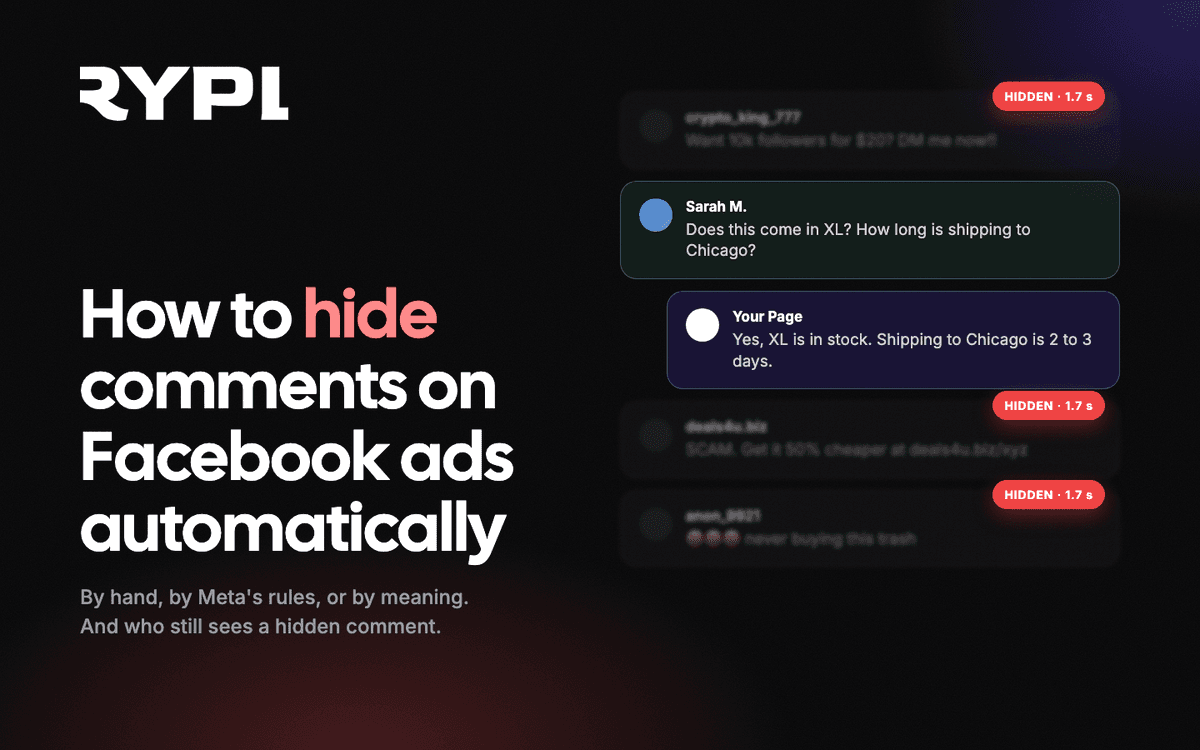
- Spam and abuse — bot comments, competitor links, profanity. These need to be hidden immediately before other viewers see them.
Without triage, your team treats a "What colors do you have?" the same as a fire emoji. One of those is a buyer. The other is not.
Responding
Speed is the variable that separates a sale from a missed opportunity. Edison Research found that 42% of consumers expect a reply within 60 minutes on social media. Yet according to Sprout Social, the average business takes 4 to 12 hours — if they reply at all.
But speed alone is not enough. The response needs to match the intent behind the comment. A pricing question should get a specific answer with product details, not a generic "Thanks for your interest." A shipping question should get a delivery estimate, not a redirect to a FAQ page. An objection like "Looks too expensive" should get reassurance backed by social proof or a value comparison — not silence.
The best ad comment responses feel like a knowledgeable salesperson who happened to be standing right there when the customer had a question.
Moderating
Your ad comment section is visible to every person who sees your ad. One toxic thread or a string of spam comments can undermine the social proof you are paying to build.
Active moderation means hiding spam before it accumulates, removing competitor links, and filtering profanity. It also means knowing what not to remove — genuine negative feedback, handled publicly and professionally, actually builds more trust than a comment section full of only positive replies.
The goal is a clean, credible comment section that makes the next viewer more likely to buy, not less.
Measuring
If you are not tracking your comment management performance, you are optimizing blind. The metrics that matter:
- Response rate — what percentage of comments actually get a reply
- Response time — how fast those replies happen
- Intent distribution — what types of comments your ads generate most
- Conversion correlation — which reply patterns lead to actual purchases
These numbers tell you which ads are generating the most buying-intent engagement, which products get the most questions, and whether your response system is actually converting attention into revenue. Without this data, comment management is just guesswork.
Manual vs. Automated: When to Use Each
Not every business needs full automation, and not every business can survive on manual replies alone. The right approach depends on your volume, your team, and the complexity of your product.
Manual comment management works when your ad comment volume stays under 20 per day, you have a dedicated person checking comments during business hours, and most of your comments require nuanced product knowledge or sensitive handling that only a human can provide.
Automated management becomes necessary when volume exceeds your team's capacity, comments arrive around the clock across multiple time zones, most questions are repetitive — pricing, availability, shipping — and response speed directly impacts whether someone buys or bounces.
The reality for most businesses running Facebook ads at any meaningful scale is a hybrid approach. AI handles the 80% of routine comments — the pricing questions, the shipping inquiries, the spam filtering — while humans focus on the 20% that need genuine personal attention. Complex complaints, high-value prospects, and sensitive situations still get a human touch. Everything else gets an instant, accurate, context-aware reply.
How AI Changes the Equation
Old-school auto-reply tools fired the same canned response regardless of what someone actually said. A pricing question and a complaint both got "Thanks for reaching out." That is not automation — it is a trust killer that signals your brand does not read what people write.
Modern AI reads the ad content, the comment context, and the thread history before generating a reply. "Is this available in blue?" on a clothing ad gets specific color availability for that product — not a redirect to your website. A complaint gets empathy and next steps. Spam gets hidden before anyone else sees it.
The 24/7 coverage matters as much as the quality. Your ads run around the clock. Every hour a buying-intent comment sits unanswered is an hour where that customer is scrolling past your competitor's ad instead.
This is what lead leakage looks like at the mechanics level. The comments are there. The intent is there. The reply is not. That gap is why we built Rypl.
Getting Started
The first step does not require any new tools. Go to your Ads Manager right now and check your most recent campaigns. Open the ad-level view and look at the comments. Count how many got a reply.
If your reply rate is below 50%, you have a leak worth fixing. If it is below 20% — which is where most businesses land — you are leaving significant revenue on the table every single week.
From there, the path forward is straightforward. Map your comment volume. Identify what percentage of comments contain real buying intent. Calculate the revenue impact using the table above. Then decide whether your team can handle that volume manually or whether you need AI to close the gap.
If it is the second, the Facebook comment moderation tool page walks through the moderation and reply side end to end.
The businesses that treat ad comments as a conversion channel — not an afterthought — consistently outperform those that do not. Your ads are already generating the conversations. The only question is whether you have a system to turn those conversations into sales.
Start your free 7-day trial and see what your ad comments are actually worth.